Last November, on the Tuesday before Thanksgiving, Bill Horstman and his wife, Esther, were running errands—getting their snowblower ready to tackle an oncoming snowstorm—when Mrs. Horstman noticed that her husband was breathing oddly and his head dropped to his chest. She immediately drove him to the UHS Chenango Memorial Hospital (CMH) Emergency Department (ED), where an evaluation indicated a possible stroke.
Mrs. Horstman called their children, including Carin Dietrich, who lives in Norwich. Ms. Dietrich immediately rushed to the hospital to be with her family.
Lifesaving care
Ms. Dietrich was very concerned about her father’s health, not only because of the possible stroke, but because he had been diagnosed with a form of blood cancer the previous spring. Despite that diagnosis, for her, the emergency came out of the blue.
“His cancer was manageable, and he was doing perfectly fine,” Ms. Dietrich said. “When my stepmother noticed my dad was not okay, she drove directly to the hospital. Nobody was going to get to him there faster.” As Norwich residents, Ms. Dietrich said that she and her family are so grateful to have access to a good hospital close to home. “We are very lucky to have Chenango Memorial here for us, because we are about an hour away from Binghamton, Utica and Syracuse. A one-hour trip is okay when you’re going shopping, but not when you need urgent medical care.”
When Ms. Dietrich arrived at UHS CMH, she was shown into the ED, where her stepmother, her father’s twin brother and a nurse were waiting for her. “They let me stand right outside my dad’s door while they were working on him and then brought us in as soon as he was stabilized,” Ms. Dietrich said. “He was intubated, so they took my stepmother aside to discuss what kind of care might be needed.”
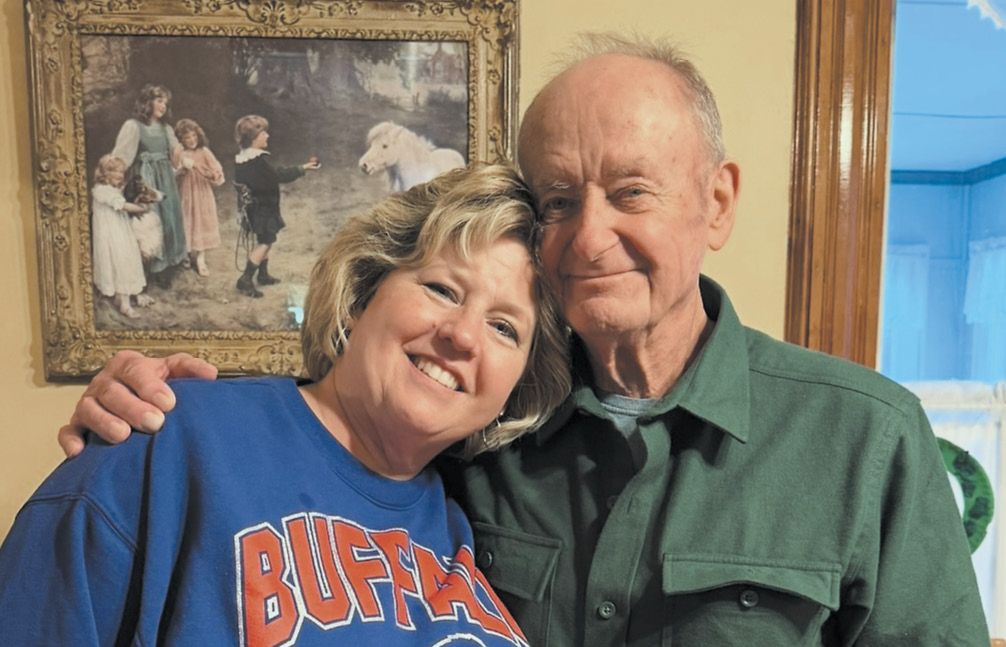
When Carin Dietrich’s father began experiencing stroke symptoms, the teams at UHS Chenango Memorial Hospital and UHS Wilson Medical Center helped him recover quickly.
Something vital
When Ms. Dietrich was allowed into her father’s room, she was very grateful for the time she was able to spend holding his hand and talking to him. She said that it was important for her father to hear her voice and feel that familiar contact. “I noticed that he was doing things like squeezing my hand and moving his feet, and eventually he opened his eyes,” said Ms. Dietrich.
As he became more responsive, the doctor asked him to perform a few maneuvers to get a sense of how the stroke might have affected him. “He was able to touch his nose, lift his leg and bend his knee,” Ms. Dietrich recalled. “He struggled with the one leg—but my dad is very stubborn. He slammed the leg down and then lifted it higher than the other one! The doctor and I were impressed with that.”
A head CT scan showed that Mr. Horstman had a blood clot near the back of his skull. The lead nurse administered tPA, a clot-busting medication commonly used to treat an ischemic stroke.
A transfer to UHS Wilson Medical Center
Once Mr. Horstman was stabilized, the care team at UHS CMH felt it would be best for him to be transferred to UHS Wilson Medical Center, where he could be cared for in the region’s only designated Comprehensive Stroke Center.
As the team prepared Mr. Horstman for transfer, his daughter continued to notice the compassionate care and attention to detail displayed by the ED staff.
“The nurse was excellent,” Ms. Dietrich said. “She was disconnecting and reconnecting everything, and getting ready to ride with him to the hospital—which I found to be incredible.
“It was a cold, wet day. As they were preparing to wheel him out, I saw his chest was exposed. I said, ‘He’s a very cold person. Can we possibly get him another warm blanket?’ and the doctor himself got it. Then we were all able to stand there and say goodbye as they took him out. They never rushed us at all. I felt that was really nice of them.”
This is the sort of care that supports the patient both medically and emotionally, and it is what UHS team members are proud to provide.
Two days after his arrival at UHS Wilson Medical Center, on Thanksgiving Day, he was up walking and visiting with family. “You would never have known that he had had a stroke,” said Ms. Dietrich. “I called the nurses at UHS CMH that morning to let them know how good he was doing, and they just couldn’t believe it.” Mr. Horstman made a swift recovery and was released about a week later. Now, he’s doing great.
Time is Crucial
If anyone experiences one or more of these symptoms, seek help quickly! The time you save getting appropriate stroke care makes a substantial difference in recovery. Remember to BE FAST:
B Balance: Sudden loss of balance or coordination.
E Eyes: Sudden blurred or double vision or loss of vision in one or both eyes.
F Face: Ask the person to smile. Does one side of the face droop?
A Arms: Ask them to raise both arms. Does one arm drift downward?
S Speech: Ask them to say a simple sentence. Is their speech slurred or strange?
T Time: If you observe any of these signs, call 911 immediately.
Here for You
Even before you need our services, you can learn about what UHS offers.