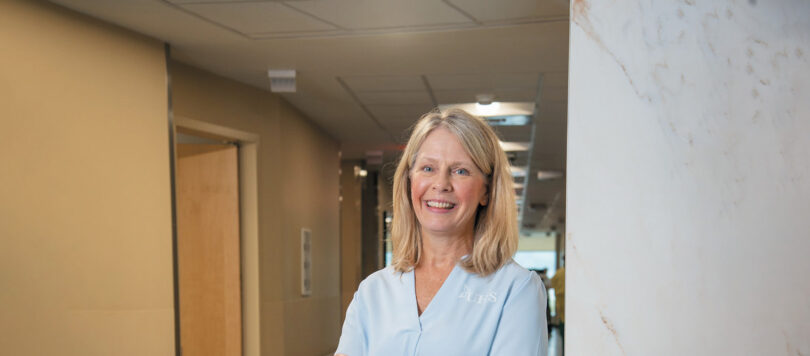
A Q&A with Chief Nursing Officer Peggy Thomas
Nursing is foundational to the mission of UHS, touching every patient, every family and every care setting across the System. As UHS continues its journey toward nursing excellence, Chief Nursing Officer Peggy Thomas, MSN, RN, CENP, shares her vision for the profession and the role nurses play in supporting the health of our communities.
Ms. Thomas joined UHS in 2022 as the Vice President for Nursing and Chief Nursing Officer (CNO) of UHS Hospitals. Recently, Ms. Thomas advanced to the role of CNO for the UHS System, where she is now responsible for setting the course for nursing practice across all UHS locations throughout the region.
In this Q&A, Ms. Thomas discusses how nursing continues to evolve at UHS through the organization’s journey to Magnet recognition, innovative approaches to supporting care teams, a focus on strengthening community partnerships and more.
Congratulations on your new role. As the leader of nursing across the UHS System, what role do nurses play in shaping the patient experience? What can patients expect when they receive care at any UHS location?
Thomas: To me, nurses are the heart of the patient experience at UHS. We are with patients and families during their most vulnerable times, playing a critical role in coordinating care, building trust and making sure patients feel safe, supported and heard.
Our goal is to see every patient as a unique individual. Our nurses meet each patient where they are and partner with them throughout their healthcare journey. We respect every individual’s decisions about their care, while demonstrating compassion and inspiring hope.
No matter what setting they’re working in, our nurses are focused on delivering safe, high-quality care centered on each patient’s needs. That’s what defines nursing at UHS: putting the patient first in everything we do.
You were instrumental in bringing the Magnet journey to UHS, introducing and championing the pursuit of the nation’s highest recognition for nursing excellence. How has that commitment influenced patient care across the organization?
Thomas: The Magnet journey has empowered our nurses to take a greater leadership role in advancing patient care. They are bringing evidence-based practice to their care, which enhances quality outcomes and strengthens the care environment for both patients and staff.
We’ve expanded our shared governance councils, giving nurses a stronger voice in making decisions about professional practice, patient care and workplace improvements. When nurses are empowered to lead, innovation follows.
Magnet is also about professional growth. We are committed to supporting nurses as they pursue advanced degrees, specialty certifications and opportunities to share knowledge and best practices that will support them in the work they’re doing now and as they advance in their careers.
What excites me most is the energy and engagement we are seeing across the organization. Nurses want to be involved and take ownership of their practice, as they continue to find innovative ways to enhance care and challenge each other to strive for the best.
An exciting new development in nursing at UHS is the introduction of a new virtual nursing program. What is virtual nursing, and what does it mean for the nursing profession?
Thomas: As healthcare becomes more complex, we recognize the need for innovative ways to support both patients and care teams. Virtual nursing adds another layer of clinical support, helping strengthen care coordination, reduce readmissions and enhance the patient experience.
Importantly, virtual nursing does not replace bedside nurses. Instead, it allows experienced nurses to assist with tasks such as patient education, documentation and triage, giving bedside nurses more time to focus on direct patient care and critical tasks. The result is improved efficiency and enhanced safety and quality outcomes for our patients.
Protecting patient privacy remains a top priority. Virtual nurses can only connect with patients in their room after receiving permission. Once they do, they use secure, high-definition technology to support care, whether that’s looking at an IV pump and checking the settings, assisting with assessing a wound, or documenting clinical information.
Community partnerships are an essential piece of the work we do at UHS. Tell us about what UHS Nursing does for our community.
Thomas: Community engagement is one of the areas I’ve looked to continue to grow in my role. While caring for the patients who come through our doors is our primary responsibility, we also play an important role in strengthening the future of healthcare in our community.
One way we do that is by partnering with area colleges and universities to support nursing education. Almost seven days a week, students are gaining valuable clinical experience at UHS. Through our new clinical faculty program, UHS nurses have the opportunity to gain experience serving as educators, helping prepare the next generation of caregivers.
We also recently launched a summer externship program, which allows nursing students who are between their junior and senior years to spend ten weeks with us, working alongside a registered nurse to gain hands-on experience in a real clinical setting. The program helps students build their skills and confidence, while also creating a strong pipeline of future nursing talent at UHS.
In addition, many of our nurses serve on the boards of various local and regional organizations. They bring insights from that service back to UHS, which helps us understand and respond to the unique needs of our community.
How would you summarize your overall vision for nursing at UHS going forward?
Thomas: I want UHS to be recognized as a model for nursing excellence, where nurses feel supported, valued and prepared to lead the future of healthcare. Achieving that vision requires continued investment in our nurses, empowering them to learn and grow in their practice.
In my role as Chief Nursing Officer for the UHS System, I’ve spent time at our locations throughout the region and developed strong partnerships with nursing leaders across the System. It’s important to understand how healthcare is delivered in the rural settings we serve, and we talk through the unique barriers patients and providers face so we can learn from each other and elevate care for everyone.
Creating a safe work environment is also a top priority. Healthcare organizations nationwide continue to face rising incidents of workplace violence, and UHS maintains a strong, zero-tolerance stance. We are committed to fostering an environment where nurses feel safe and respected, and can find joy and purpose coming to work.
Ultimately, my vision is for nursing at UHS to reflect high standards of quality, professionalism and compassion. If every patient feels seen, heard, supported and cared for, then we know we are fulfilling our mission.